
The biggest difference between driving at night and during the day is the difference in visibility. It sounds obvious, but when driving at night, your ability to see and the ability of other road users to see you is reduced. Other effects caused by reduced light levels are:
Most urban roads are lighted. Move away from an urban centre, and you will find most roads have no lighting other than cat's eyes - reflective studs which mark the centre of the road and sometimes the left-hand edge.
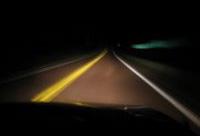
Night Driving - Rural Roads
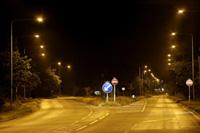
Night Driving - Urban Roads
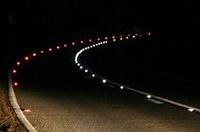
Night Driving - Cats Eyes
The first rule of driving on roads that have no lighting is -
never drive at a speed where you would be unable to stop within the distance your headlights show to be clear.
The lights on a car have two purposes - they help you see at night, and they help other road users see you. You don't have to wait for the night time before you turn on your car lights or, for that matter, until the street lights come on. If light levels dip, whatever time of day, then turn on your lights. It is certainly wise to have your lights on as dusk approaches.
Your headlights have two settings: dip and full beam. When driving at night on lit roads, you should have your headlights switched to dip. A standard set of headlights will provide about 30 metres of visibility when dipped and about 100 metres when on full beam.
Urban Areas
Full Beam Headlights
When driving on unlit roads and when no other traffic can be seen ahead of you, you should turn your headlights on full beam. When you see a vehicle, pedestrian or cyclist approaching, you must turn the headlights to dip. Remember the Highway Code states - do not use any lights in a way that would dazzle or cause discomfort to other road users, including pedestrians, cyclists and horse riders.
On a straight level road, when you see another vehicle approaching, you should turn your headlights to dip a second after they can see you. This shows them that you have gone onto dip and may remind them to do the same. You should then slow down, as the distance you can see to be clear will be reduced.
Look towards the nearside of the road, the left, and try not to look at the approaching headlights, as this may affect your night vision. If no other traffic is approaching, return to full beam as soon as the vehicle has passed you.
When driving around corners and over brows, you should dip your headlights early before any approaching driver appears in view.
Overtaking
Overtaking another vehicle whilst driving at night can be a risky endeavour. Remember, your view ahead will be limited by the darkness. Bends and dips in the road can be cloaked in darkness. These can easily hide other road users, whether cars or pedestrians. Never takes risks. Be certain that the road ahead is clear. Once you have drawn level with the vehicle you are overtaking switch your headlights to full beam if there are no other vehicles ahead of you.
If a driver overtakes you then keep your headlights on full beam until they are level with you. The extra light will help them overtake you safely. Once they pull past you turn you headlights to dip.
Dazzle
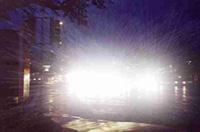
One of the biggest night time hazards is dazzle, caused by the light from on-coming headlights.
For newly qualified drivers, driving at night for the first few times can be a shock to the system, especially in busy traffic on unlit roads.
During the day, light is pretty well evenly distributed but at night intense light sources cut through the black making it hard on your eyes and sometimes even acting to disorientate you. This light also causes dazzle.
To avoid dazzle:
Maintenance
Car lights need to be cleaned regularly. Light covers that are covered in grime can prove to be ineffective. You will find it harder to see the road, and other road users will find it harder to see you.
Clean your windscreen regularly and make sure you have a good windscreen washer concentrate in your windscreen washer reservoir. A clean windscreen will reduce dazzle.
Interior Lights
Turn off your interior lights and dim the dashboard if possible - this will cut down on interior reflections on your windows.
Carry a Spare Light Bulb Set
Light bulbs can go at anytime, so it's always wise to carry a spare. Also, if you are stopped by the police foe having a broken light, they cannot charge you if you are able to replace the defective bulb. This will save you a fine, points on your licence and an automatic breathalyser test.
Driving at night is a skill that needs to be learnt. As learner drivers you are not required to have lessons in driving at night however, for safety's sake, you may find it useful to ask your instructor for a few night time lessons just be sure.