
How To Drive Through A Bend
The first assessment you should make when approaching a bend is how sharp it is. If you get this wrong, you may skid and lose control of your car.
From your assessment of how sharp the bend is, your next question should be, is my current speed appropriate?
Remember the golden rule – you must be able to stop, on your side of the road, in the distance you can see to be clear.
To help you assess these points correctly, you need to pay attention to your surroundings. Look out for road signs and markings that signal the direction of the bend.

Right-handed bend (left if symbol reversed)

Double bend (first to left)

Junction on a bend ahead

Sharp deviation in the direction indicated
If there are no signs or markings, then observe how the line of trees, hedgerows, buildings or street lights lining the road flow. This can give you a fair assessment of how sharp the bend is.
Sometimes you may see skid marks on the road. These can indicate that a recent driver misjudged the bend and had to slam the brakes on to keep control.
- As you drive towards a bend, apply the MSM/PSL routine.
- Slow down in good time and select a lower gear if needed, as this will give you more control. It can be dangerous to change gear whilst cornering as it means removing your hand from the steering wheel.
- As you enter the bend, turn the steering wheel smoothly and progressively.
- You should not apply the brakes as you steer round the bend.
- For the best grip, the engine should be under acceleration. This doesn’t mean you should increase your speed in the bend but means the engine should be pulling the car.
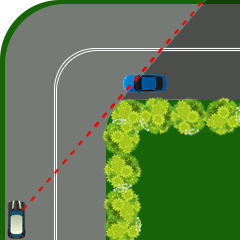
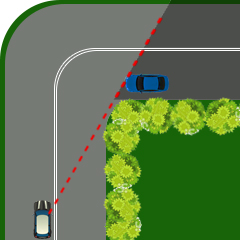
When taking a right-hand bend, position your car towards the left of the lane, as this will:
- increase your zone of vision into the bend
- keep you out of the path of approaching traffic
- give you more time to deal with any other hazard in the bend.
Positioning your car towards the left gives you a better view in a right-hand bend
When taking a left-hand bend
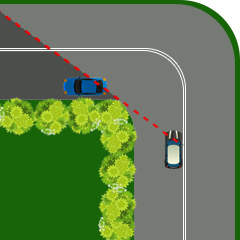
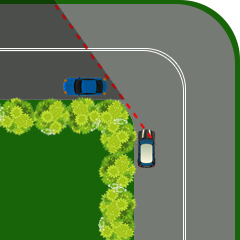
- Keep your car in the centre of the lane. This will keep you out of the path of approaching traffic, for example, a large vehicle may be coming the other way and maybe edging into your lane.
- Do not get too close to the left, as this is likely to restrict your view of the road ahead and give you little time to deal with hazards in the bend.
- As you enter the bend, turn the steering wheel smoothly and progressively.
As you leave a bend, check your mirrors and gently accelerate to an appropriate speed for the road and traffic conditions.
Positioning your car too close to the left will restrict your view.
In Wet Weather
Taking a bend becomes even trickier when the road surface is wet. In the wet, your tyres will have less grip on the road. Take a bend too quickly, whether in the wet or not, and you are likely to lose grip and skid out of control.
When taking a left-hand bend
Another way to take a bend is by using the limit point analysis method. The limit point is the point at which the right and left-hand sides of the bend meet. This point will be the most distant point of the bend you can see. (see the photo below).
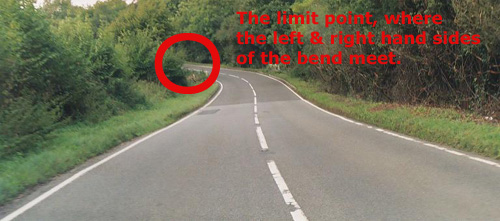
To use this technique as you approach the bend be sure that, if needed, you could stop before you reached the limit point.
Then ask yourself is the limit point getting further away? If it is and you can see further ahead then your speed is fine.
If it is getting closer you should continue to reduce your speed until the limit point begins to move with you and your view opens up again.